Nha Trang is a coastal city in south-central Vietnam with a long curved bay, a wall of hotels along the seafront, and a reputation that divides visitors more sharply than almost anywhere else in the country.
What it actually is
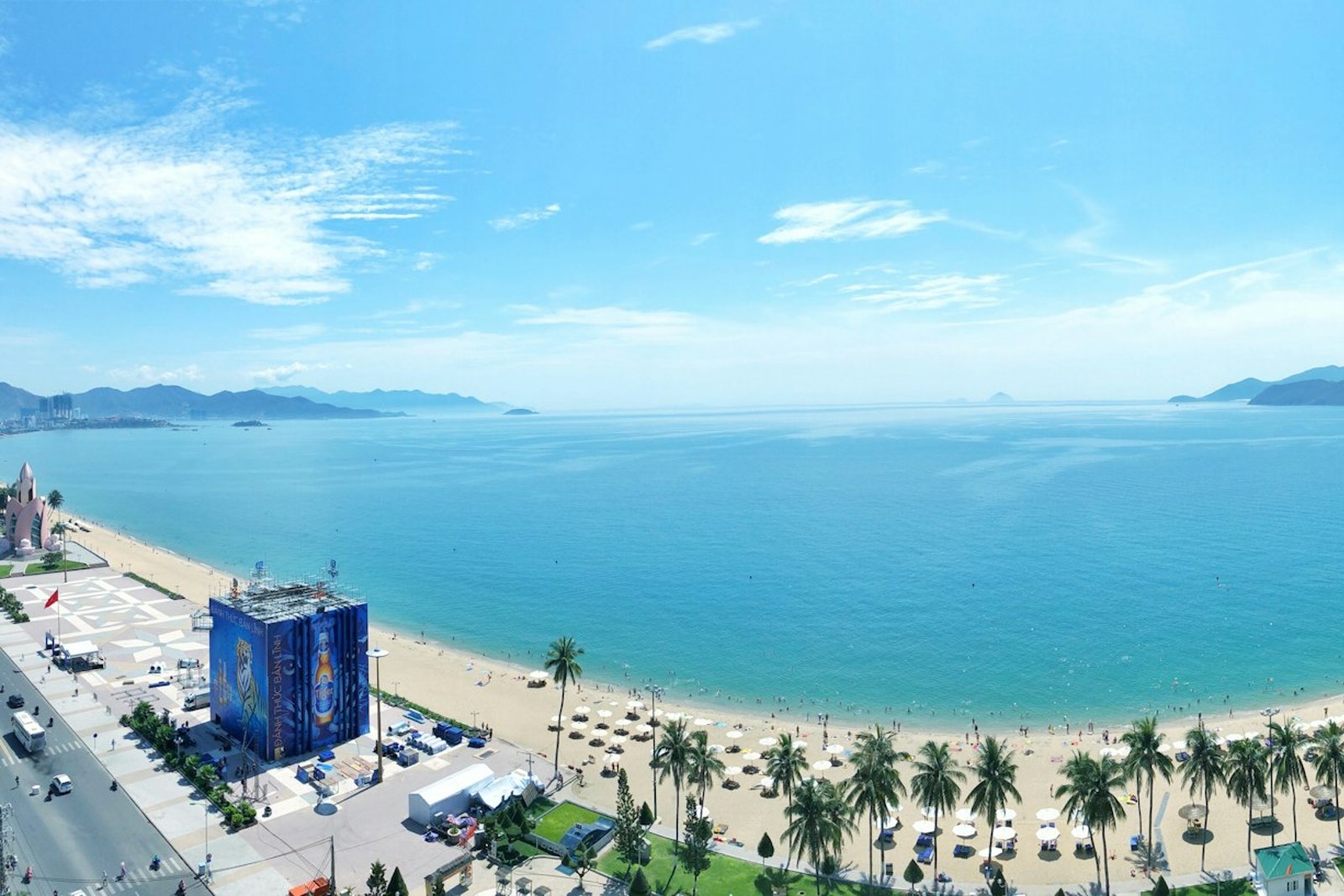
A city of several hundred thousand people with a beach running down one side of it, not a beach resort with a town attached. The seafront is a boulevard of high-rise hotels; behind it is a working Vietnamese city with markets, traffic and ordinary streets.
It has also been a major destination for Russian and, more recently, Korean and Chinese package tourism, and the signage, menus and businesses along the front reflect that. Visitors who expected a Vietnamese fishing town are often surprised; visitors who wanted a city with a beach are not.
The bay and the Cham towers: Nha Trang · Po Nagar Cham Towers. (Enable JavaScript for the interactive map.)
The beach
Six kilometres of sand along the bay, publicly accessible along its length, with a landscaped promenade behind it. The municipal beach is busy, clean, and used heavily by locals early in the morning and in the evening.
The water is clear through the dry months and the bay is sheltered by islands. In the wet season it can be rough and murky, and that difference is the single biggest factor in whether visitors enjoy the place.
Diving and the islands
Nha Trang is one of Vietnam's main diving centres, with operators running out to the islands in the bay and to Hon Mun marine protected area. Visibility and marine life are better than most of the Vietnamese coast, though divers who have been to Indonesia or the Philippines tend to find it modest.
Boat trips to the bay islands are the standard day out: Hon Mun for snorkelling, Hon Tam and Hon Mot for beaches, and the party-boat versions that are a different proposition entirely. Ask which kind you are booking.
Po Nagar and the Cham towers
On a rise above the Cai river at the northern edge of the city stand the Po Nagar Cham towers, built between roughly the eighth and eleventh centuries and still an active place of worship. They are the city's main historical site, and an hour is a reasonable allowance for them.
The Long Son Pagoda, with its large white seated Buddha on the hill behind, is the other main sight, and the view from the top covers the city and the bay.
The mud baths
Nha Trang's mineral mud baths are a local institution and a genuinely odd afternoon — communal or private tubs of warm mud, then mineral pools and showers. Several centres operate on the outskirts of the city. It is touristy and it is also fun.
Where to stay
The seafront strip has the hotels with the view and the highest prices. A block or two back the same standard costs considerably less and the beach is still a short walk. The northern end towards Po Nagar is quieter; the southern end towards the port has the newer high-rise developments.
Bai Dai, a long beach between the city and the airport, has its own resorts set well apart and little else along it. It is a different proposition: quiet, and dependent on the property you book.
Eating
Seafood, and a lot of it, sold by weight at restaurants along the front and in better value at the places a few streets back. Nem nuong Ninh Hoa — grilled pork skewers rolled at the table with rice paper, herbs and a thick dipping sauce — is the regional dish to look for.
The Dam market and the streets around it are where to eat away from the seafront, at a fraction of the price.
When to go
Nha Trang's dry season runs roughly January to August, which puts it out of step with the central coast immediately north of it. September to December is its wet period, with the heaviest rain and the roughest sea in October and November.
That makes it a useful summer beach when Hoi An and Da Nang are hot and humid, and a poor choice in late autumn.
Getting there
Cam Ranh International Airport is around forty minutes south of the city and takes domestic and regional flights. The north-south railway stops in the city centre, and the overnight train from Ho Chi Minh City is a reasonable way to arrive. Buses run everywhere.
Day trips
Inland from the city, the Ba Ho waterfalls and the Hon Ba nature reserve make half-day trips into the hills. The Thap Ba hot springs sit on the way to the Cham towers. Doc Let, a long white beach about an hour north, is where people go when the city beach is not what they wanted.
Is it worth a stop
If you want a beach day in the middle of a long overland route, and you are passing through anyway, yes. If you are choosing a Vietnamese beach destination deliberately and the surroundings matter, there are quieter options. And if the Cham towers or the diving are the draw, those are reasons to come in their own right.
FAQ
What is Nha Trang actually like?
A city of several hundred thousand people with a beach running down one side of it, not a beach resort with a town attached. The seafront is a boulevard of high-rise hotels; behind it is a working Vietnamese city with markets, traffic and ordinary streets.
What is the beach at Nha Trang like?
Six kilometres of sand along the bay, publicly accessible along its length, with a landscaped promenade behind it. The municipal beach is busy, clean, and used heavily by locals early in the morning and in the evening.
Is Nha Trang good for diving?
Nha Trang is one of Vietnam's main diving centres, with operators running out to the islands in the bay and to Hon Mun marine protected area. Visibility and marine life are better than most of the Vietnamese coast, though divers who have been to Indonesia or the Philippines tend to find it modest.
Keep planning
Not sure how it all fits together?
Pick your trip length and we'll route a real day-by-day plan.