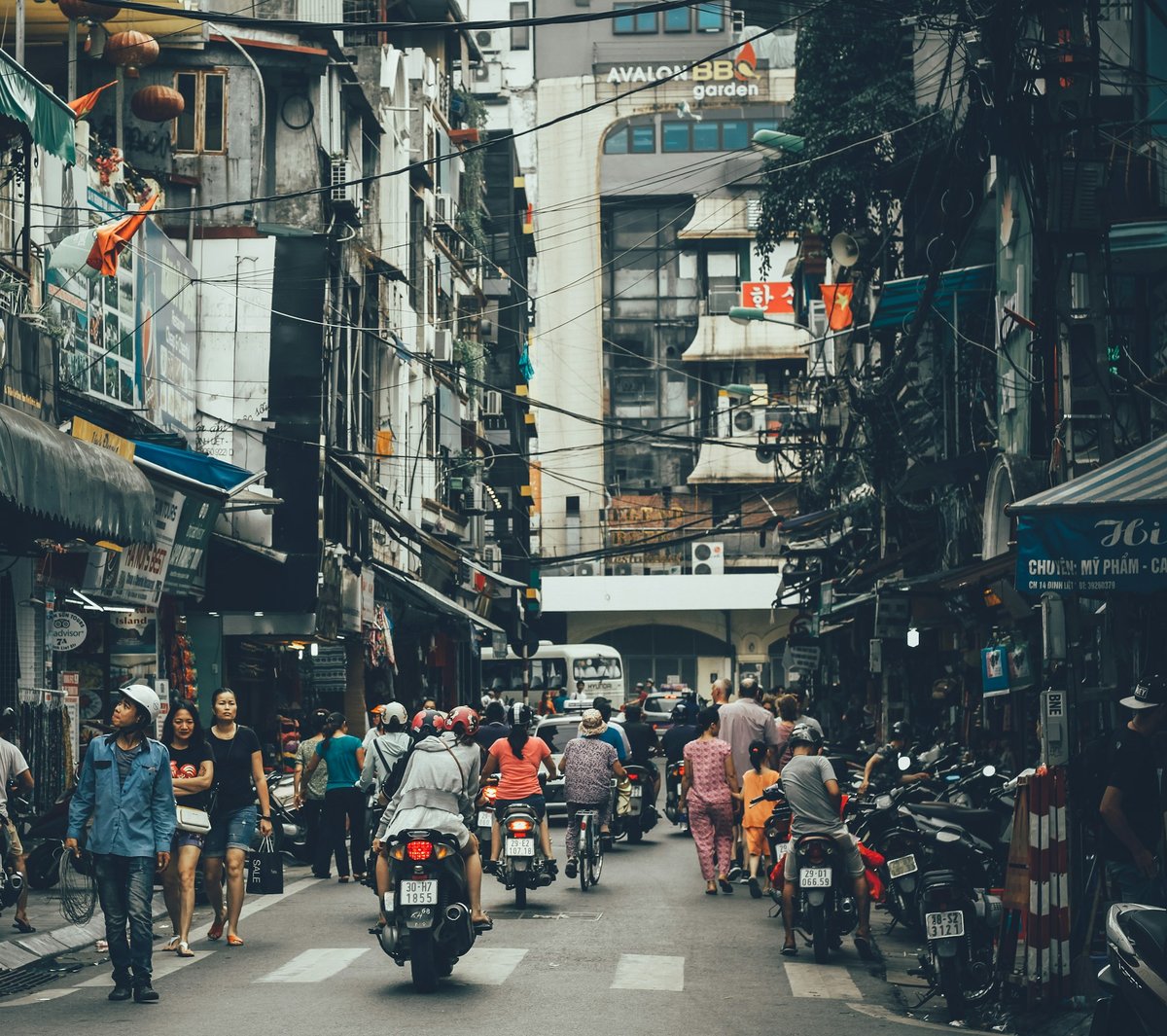
Hanoi is more walkable than it first looks and more congested than any map suggests. The short version: walk the central district, use Grab for everything beyond it, and do not plan around the metro.
Walking
The Old Quarter, Hoan Kiem and the French Quarter form a compact area you can cross on foot in twenty minutes, and walking is the only way to see any of it properly. The complication is that pavements are routinely parked solid with motorbikes, so pedestrians walk in the road as a matter of course.
That sounds alarming and is normal. Traffic flows around people who move at a steady, predictable pace. Walk with the traffic beside you where you can, and expect scooters on the pavement too.
Crossing
Step out at a slow constant pace, keep going, keep watching. Riders who have seen you can steer around a path they can predict, which is why stopping halfway causes problems — but you keep watching because not every rider has seen you. Cars and buses are a different matter: wait those out. Crossing alongside a local for the first few goes is the fastest way to learn it.
Grab, and the apps
Grab is the default for any distance beyond walking, and it is the single most useful thing to install before you arrive. It works on a foreign phone number and a foreign card, and it fixes the fare before the ride, so there is no meter to disagree about at the end.
Two products matter: GrabCar, an air-conditioned car, and GrabBike, riding pillion behind a driver who hands you a helmet. GrabBike is markedly faster through congestion and costs a fraction of the car. It feels alarming for about four minutes. Be and Xanh SM are the main competitors, Xanh SM running electric cars and bikes, and having a second app installed is useful at peak times.
Taxis
Metered taxis are legitimate and widely used, and the established companies are fine. The reason to prefer an app is not safety but price certainty: the fare is agreed before you get in, and there is nothing to argue about at the end. If you do take a street taxi, make sure the meter is running.
The metro, honestly
Hanoi has an operating metro — Line 2A from Cat Linh to Ha Dong, and a section of Line 3 — and it is clean, cheap and pleasant. It is also built for commuters rather than visitors: the lines run out to the southwest and west rather than between the places tourists go.
Ride it once if you are curious. Do not plan an itinerary around it. The network that would make it useful to visitors is still under construction.
Buses, cyclos and bicycles
Public buses are extremely cheap and comprehensive, and the 86 express from Noi Bai airport to the Old Quarter is genuinely useful. Beyond that route, the system is hard to use without Vietnamese and the time cost rarely beats a Grab.
Cyclos — the three-wheeled pedal rickshaws — are a tourist ride rather than transport, priced accordingly, and the classic place for a price misunderstanding. Agree the number and the duration before you sit down. Cycling is pleasant around West Lake and not advisable in the Old Quarter.
Renting a motorbike
Short version: do not. A US licence and an International Driving Permit are both invalid in Vietnam, riding without a Vietnamese licence is illegal, and your travel insurance may decline a claim after an accident. A GrabBike is not the same experience — you are a passenger rather than a rider — but it puts you on two wheels in the traffic with a local at the handlebars, for a couple of dollars.
Traffic, and when to avoid it
Hanoi's congestion is predictable enough to plan around. The worst periods are roughly seven to nine in the morning and five to seven in the evening, when a journey that takes fifteen minutes at midday can take forty. The Old Quarter's narrow streets clog with delivery vehicles in the late morning.
If you have a fixed appointment — a train, a tour pickup, an airport run — add half an hour to whatever the app estimates during those windows. A GrabBike slips through congestion that stops cars entirely, which is the argument for it beyond price.
Rain changes everything
A heavy downpour empties the pavements, fills the apps and floods some streets within minutes. Grab wait times climb sharply and surge pricing follows. The local solution is a one-dollar plastic poncho bought from any street corner and simply carrying on; the visitor solution is usually to sit it out in a cafe, which is also pleasant.
Getting to and from the airport
Getting to and from the airport
Noi Bai is about sixteen miles north and takes forty-five minutes to an hour, longer in peak. Grab is the simplest option and the pickup point is signposted, though it is a short walk from arrivals. The 86 express bus runs to the Old Quarter for a fraction of the price and takes about an hour. Allow well beyond the quoted journey time for a departure that falls in the morning peak.
FAQ
Is Hanoi walkable?
The Old Quarter, Hoan Kiem and the French Quarter form a compact area you can cross on foot in twenty minutes, and walking is the only way to see any of it properly. The complication is that pavements are routinely parked solid with motorbikes, so pedestrians walk in the road as a matter of course.
Should you use Grab in Hanoi?
Grab is the default for any distance beyond walking, and it is the single most useful thing to install before you arrive. It works on a foreign phone number and a foreign card, and it fixes the fare before the ride, so there is no meter to disagree about at the end.
Is the Hanoi metro useful for visitors?
Hanoi has an operating metro — Line 2A from Cat Linh to Ha Dong, and a section of Line 3 — and it is clean, cheap and pleasant. It is also built for commuters rather than visitors: the lines run out to the southwest and west rather than between the places tourists go.
Keep planning
Not sure how it all fits together?
Pick your trip length and we'll route a real day-by-day plan.