Hanoi · Ha Long Bay · Hue · Hoi An · Da Nang · Ho Chi Minh City · Mekong Delta · Phu Quoc · Sapa
Vietnam for AmericansFor American travelers

Hanoi Old Quarter Guide

Thirty-six streets, each once dedicated to a trade, still largely doing the same jobs. Here is how to read the district rather than get lost in it.

Editorial
Written and fact-checked for American travelers
·5 min read·
Hanoi Old Quarter Guide
On this page
  1. 01The thirty-six streets
  2. 02What to actually see
  3. 03The rhythm of the day
  4. 04Eating your way through
  5. 05Where the quarter ends
  6. 06Shopping, and the price question
  7. 07Shopping, and the price question
  8. 08FAQ

The Old Quarter is the reason most people remember Hanoi. It is a thousand-year-old commercial district that never stopped being commercial, and understanding its underlying logic turns an overwhelming tangle into something you can navigate.

The thirty-six streets

The district grew as a cluster of craft guilds, each occupying its own street and each named for what it sold. The prefix Hang means merchandise, and what follows is the product: Hang Bac is silver, Hang Gai silk, Hang Ma votive paper and festival decorations, Hang Thiec tin.

Much of that survives. Walk Hang Thiec and you will pass a row of metalworkers hammering; Hang Ma is still a street of red and gold paper goods and becomes spectacular before Tet and Mid-Autumn. Others have turned over to tourism, but the pattern holds often enough to be useful: if you see one shop selling something, the next six will sell it too.

Navigating

Street names change every block, which makes the district feel larger and more confusing than its actual footprint. Use the lake as your southern anchor and St Joseph's Cathedral as a western one. Beyond that, being briefly lost here is the point rather than a problem.
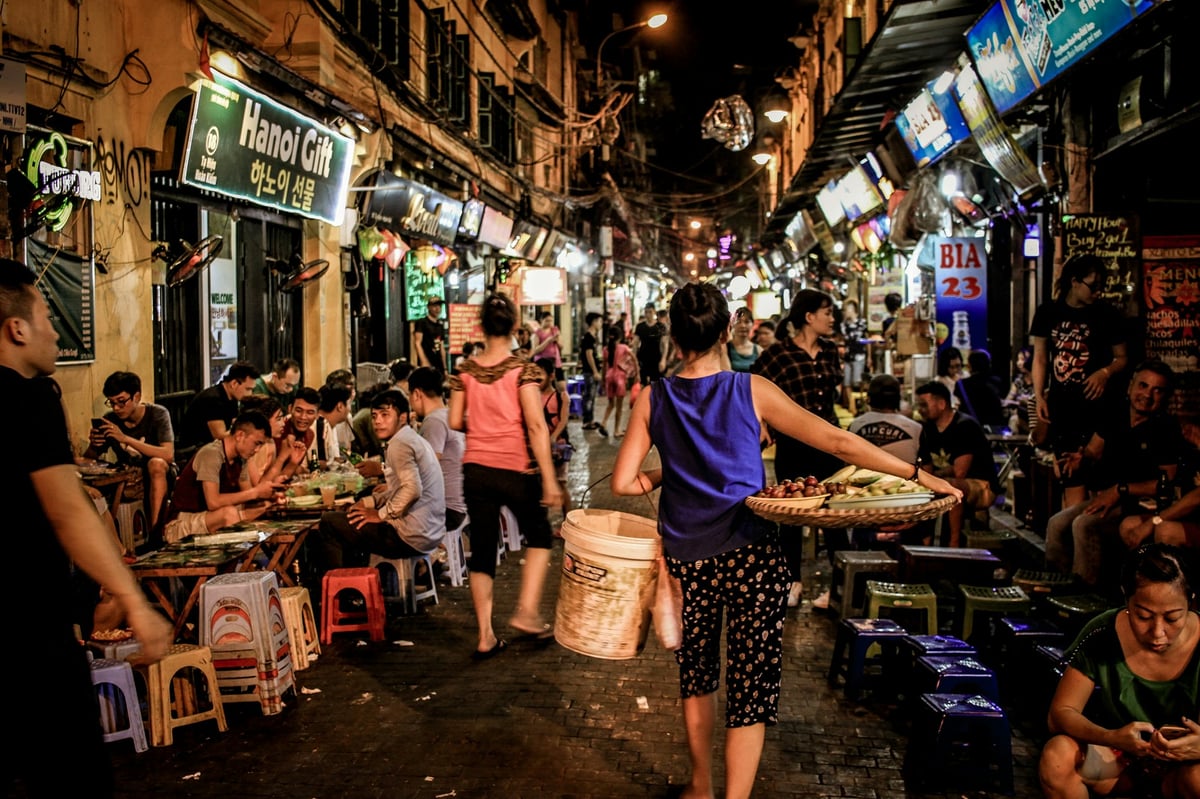
Diners on low plastic stools at a crowded Hanoi street-food corner at night

What to actually see

Dong Xuan Market at the northern edge is the district's wholesale heart, three floors of fabric, household goods and dried everything. It is a working market rather than a souvenir one, which is what makes it worth an hour.

Bach Ma Temple, the oldest in the quarter, is a small dark hall on Hang Buom that most people walk past. The Heritage House at 87 Ma May is a restored merchant's home that shows how these narrow tube houses actually worked — deep, thin plots with internal courtyards, built to a shape that made the most of very narrow street frontage.

St Joseph's Cathedral, neo-Gothic and weathered almost black, anchors a square that has become one of the better places in the city to sit with a drink in the late afternoon.

The tube houses

Look at the shape of the buildings and the district's history becomes legible. Frontage onto the street was taxed, so merchants built narrow and deep — plots two or three metres wide running twenty or more metres back, with internal light wells and courtyards to keep the far end habitable. The usual explanation offered locally is that street frontage was taxed.

You can still walk through several. The restored house at 87 Ma May is the obvious one, but many shops are tube houses with a family living behind and above the business, which is why a cafe entrance sometimes looks like somebody's corridor. It usually is.

The rhythm of the day

The quarter runs on a schedule worth knowing. Before seven it belongs to pho shops and exercise; mid-morning the shops open and the deliveries clog the lanes; the early afternoon is the quietest it gets; from five the bia hoi corners fill and the night market sets up at weekends; after ten the shutters come down street by street.

Seeing it twice — once at six in the morning and once at nine at night — tells you more about Hanoi than any museum.

Bia hoi corner

The junction of Ta Hien and Luong Ngoc Quyen is the famous one: fresh draught beer brewed that morning, served on plastic stools on the pavement for less than a dollar. It is crowded, loud and genuinely good fun early in the evening, and it is why you do not want a bedroom window directly above it.


Eating your way through

The Old Quarter packs an extraordinary amount of good cheap food into a small area. Bun cha at lunch, banh cuon in the morning, cha ca on the street named after it, and egg coffee in an upstairs room reached through what looks like somebody's hallway — several of the best cafes are hidden behind shops.

The selection rule is turnover: a queue of locals and food cooked in front of you. Tidiness is a weaker signal than throughput.

Where the quarter ends

The Old Quarter is smaller than it feels — roughly a kilometre across — and knowing its edges helps. Dong Xuan Market marks the north, the lake the south, Hang Da and the cathedral the west, and the river embankment the east. Step over any of those and the streets tend to widen and the density to drop, often with prices following.

That matters practically: walk five minutes east towards the river and you are in an ordinary residential Hanoi with ordinary Hanoi prices, which is often where the better pho is.

Staying here, briefly

Sleeping in the quarter puts everything at the door and the noise in the room. Scooters start before six and the bar corner runs late. Ask for a room at the back, above the second floor, and check how many streets separate you from Ta Hien before you book.

Shopping, and the price question

Shopping, and the price question

Hang Gai sells silk and tailoring, Hang Bac silver, and the streets around Dong Xuan sell everything else. Bargaining is expected in markets and with street vendors, not in shops with marked prices.

The common complaint is not dishonesty but ambiguity — a service performed before a price is agreed, then an aggressive number. Settling the price first, in dong, removes the ambiguity that makes it possible.

FAQ

Why is Hanoi's Old Quarter called the thirty-six streets?

The district grew as a cluster of craft guilds, each occupying its own street and each named for what it sold. The prefix Hang means merchandise, and what follows is the product: Hang Bac is silver, Hang Gai silk, Hang Ma votive paper and festival decorations, Hang Thiec tin.

What should you see in Hanoi's Old Quarter?

Dong Xuan Market at the northern edge is the district's wholesale heart, three floors of fabric, household goods and dried everything. It is a working market rather than a souvenir one, which is what makes it worth an hour.

What time of day is best in the Old Quarter?

The quarter runs on a schedule worth knowing. Before seven it belongs to pho shops and exercise; mid-morning the shops open and the deliveries clog the lanes; the early afternoon is the quietest it gets; from five the bia hoi corners fill and the night market sets up at weekends; after ten the shutters come down street by street.

Keep planning
Not sure how it all fits together?

Pick your trip length and we'll route a real day-by-day plan.

Build your trip →