Vietnam with Limited Mobility: Where It Works and Where It Does Not
Vietnam's pavements, boats and old towns are hard on anyone who walks with difficulty. The trip is still possible, and the way to make it work is to choose the places and the transport that fit.
Editorial Written and fact-checked for American travelers
Vietnam is a difficult country for a wheelchair user and a tiring one for anyone who walks with a stick, with a bad knee or with a parent in their eighties. The obstacles are specific: pavements used as motorbike parking, kerbs without ramps, bathroom doors narrower than a chair, and sights that involve stairs, boats and distance. None of that is a reason to stay home. It is a reason to plan the trip around what works, which is more than the pavements suggest.
The short version
Vietnam with limited mobility works when the trip is built on a car with a driver, hotels in the newer mid-range and upper brackets, and a shortlist of flat, compact places. It does not work as a backpacking trip, a motorbike trip or a trip built on the sights that need stairs and boats.
Da Nang, Hoi An's old town, Ho Chi Minh City's centre, Hue's citadel and the Mekong's bigger towns are the reliable core; Sapa, the Ha Giang loop and the cave trips are not.
What Vietnamese people will do
Help, unasked, and lift. A wheelchair at a step or a boat will attract hands before you have finished looking for them. It is generous and it is not a substitute for a ramp, and for anyone who does not want to be lifted it is worth saying so early.
The transport that works
A car with a driver is the piece of equipment that makes Vietnam accessible, and it is the standard way a visitor with limited mobility sees the country. A driver takes you door to door, waits, helps with the chair, and removes the pavement problem for every journey that is not on foot. Within cities, ride-hailing cars do the same job for short hops; the apps let you request a larger vehicle, and the driver meets you at the kerb.
Taxis from the major companies are fine; motorbike taxis are not.
Trains are the transport to avoid: carriages are reached by steep steps from low platforms, corridors are narrow and the toilets are not usable from a chair. Domestic flights are the long-distance answer, and the airlines provide wheelchair assistance when it is requested at booking, which is a thing to confirm by phone rather than assume. Long-distance coaches are workable for someone who can climb a few steps and not otherwise.
Airports
The international airports have lifts, assistance desks and accessible toilets. The bottleneck is between the terminal and the hotel, where the fixed-fare airport taxi or a pre-booked car with a driver beats anything that needs a kerb.
The places that work
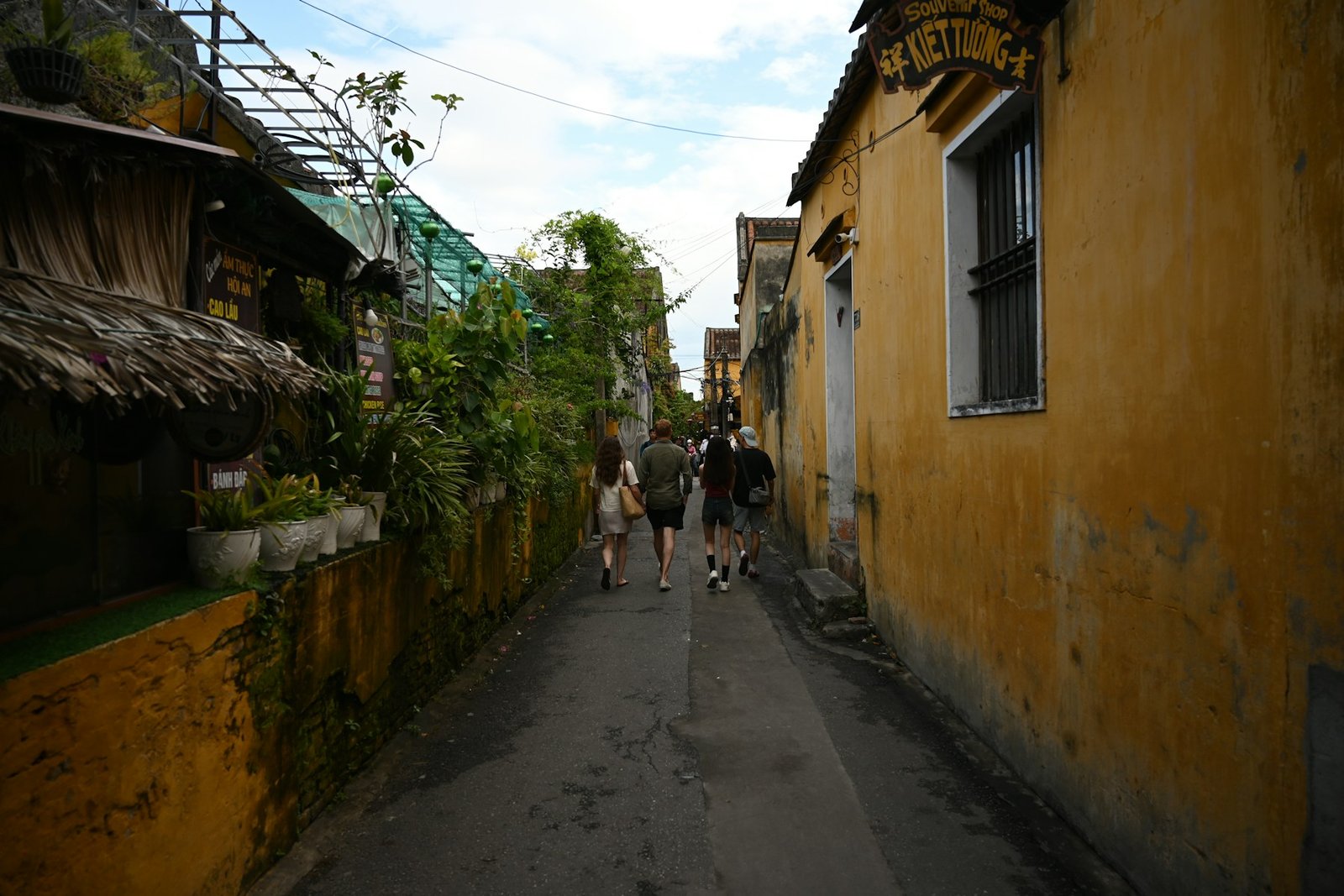
Hoi An's old town is flat, closed to cars for much of the day, and compact enough to cover slowly; the paving is uneven in places and the crowds thick in the evening, but it is the most rewarding walkable town in the country for anyone who tires easily. Da Nang has wide new pavements, a long beachfront with ramps, and hotels built this decade.
Ho Chi Minh City's central district is flat, with the main museums and the cathedral square within a short drive of each other and lifts in the larger buildings. Hue's citadel is flat ground with raised thresholds at the gates, which a helper can manage with a chair.
In the Mekong Delta, Can Tho's riverfront is level and the floating market is seen from a boat, which raises the boarding question but not a walking one. Nha Trang and Phu Quoc's resorts are built for guests who do not want stairs, and a beach week there is the easiest part of any itinerary.
Hanoi
Hanoi is harder: the Old Quarter's pavements are the most obstructed in Vietnam, and the sights are spread out. It still works from a car, with the Temple of Literature, the Ho Chi Minh complex and the lake front each a short drive apart and mostly level once inside. Walking the Old Quarter is the thing to drop, not the city.
The places that do not
Sapa is a town of steep streets with treks around it, and the terraces are seen on foot or from a motorbike. Ha Long Bay's cruise boats are boarded by tender and have stairs between decks; some operators will manage a chair with notice, and the cheaper boats will not. Ninh Binh's rowboats are stepped into from a low jetty, which a steady person with a helper can do and a wheelchair user cannot. The Cu Chi tunnels are tunnels.
The Phong Nha show caves have long staircases. The Hang Mua viewpoint is a climb of several hundred steps.
Temples and pagodas across the country have thresholds to step over, which is deliberate, and often a flight of steps at the gate. Most are worth seeing from the courtyard, and the courtyard is usually reachable.
The halfway cases
Someone who walks slowly but can manage a few steps and a boat with help has a much longer list than a wheelchair user: Ha Long with the right operator, a Ninh Binh boat, the Imperial City, the Marble Mountains by lift to the main level. The question to ask any operator is not "is it accessible" but "how many steps, and is there a handrail".
Hotels and bathrooms
The newer mid-range and upper hotels have lifts and some have rooms with wider bathroom doors and walk-in showers; the older guesthouses and the budget hotels have neither, and bathroom doorways too narrow for a standard chair are the norm outside the top tier. Ask for the bathroom door width and whether the shower is step-free, in writing, before booking, and book hotels in Vietnam from the international chains or the newer resorts where that answer is reliable.
Toilets in town
Accessible public toilets are rare. Hotel lobbies, the larger shopping malls, and international-standard restaurants are the dependable options, and a day out should be planned around them.
Planning the trip
Build the itinerary as a loop of the places that work, joined by flights and a driver, and give each one more days than a fit traveller would, because the point is to be there rather than to cover it.
Da Nang and Hoi An, then Hue by car over the pass, then a flight south to the city and a driver into the delta, with a beach week at the end, is a two-week trip that asks for no stairs that cannot be avoided. Specialist agencies that arrange accessible travel in Vietnam exist and know which hotels and boats will actually manage a chair; using one is cheaper than finding out on arrival.
Keep planning
Not sure how it all fits together?
Pick your trip length and we'll route a real day-by-day plan.