Hoi An and Da Nang are usually booked as one leg of a trip, which makes the accommodation question more complicated than it looks: you are choosing not just a hotel but which of six quite different areas you wake up in. This page describes each one and who it suits.
Hoi An: inside the Ancient Town
Small hotels and converted houses on and immediately around the old streets. You walk to the restaurants, the tailors, the riverside and the lantern-lit streets at night, and you can be out in the town at the hours when it is quietest. (This article contains affiliate links — if you book through them we earn a small commission at no extra cost to you.)
The trade is noise and traffic. The old town is busy through the middle of the day, and some streets carry bar noise late. Ask for a room at the back, and look at where the hotel sits relative to the main nightlife street before booking.
Hoi An: the edge of town and the paddies
A ring of mid-size resorts and guesthouses sits in the rice fields a few minutes out, between the Ancient Town and the beach. Prices tend to be lower than in the centre for more space, and many have pools.
You will use a bicycle or a Grab for everything. That is a mild inconvenience in daylight and a decision to make each evening.
Where the two towns sit: Hoi An · Da Nang. (Enable JavaScript for the interactive map.)
An Bang and the Hoi An beaches
Low-rise guesthouses, villas and small resorts behind a wide beach, roughly ten to fifteen minutes from the Ancient Town by bicycle. Beach restaurants, a slower pace, and sand at the door.
It suits longer stays and families. The limitation is the same one that makes it pleasant: you are not in the old town, so evenings there take planning. During the September-to-November storm season the beach is the part of the proposition that fails first.
Da Nang: My Khe and the beachfront
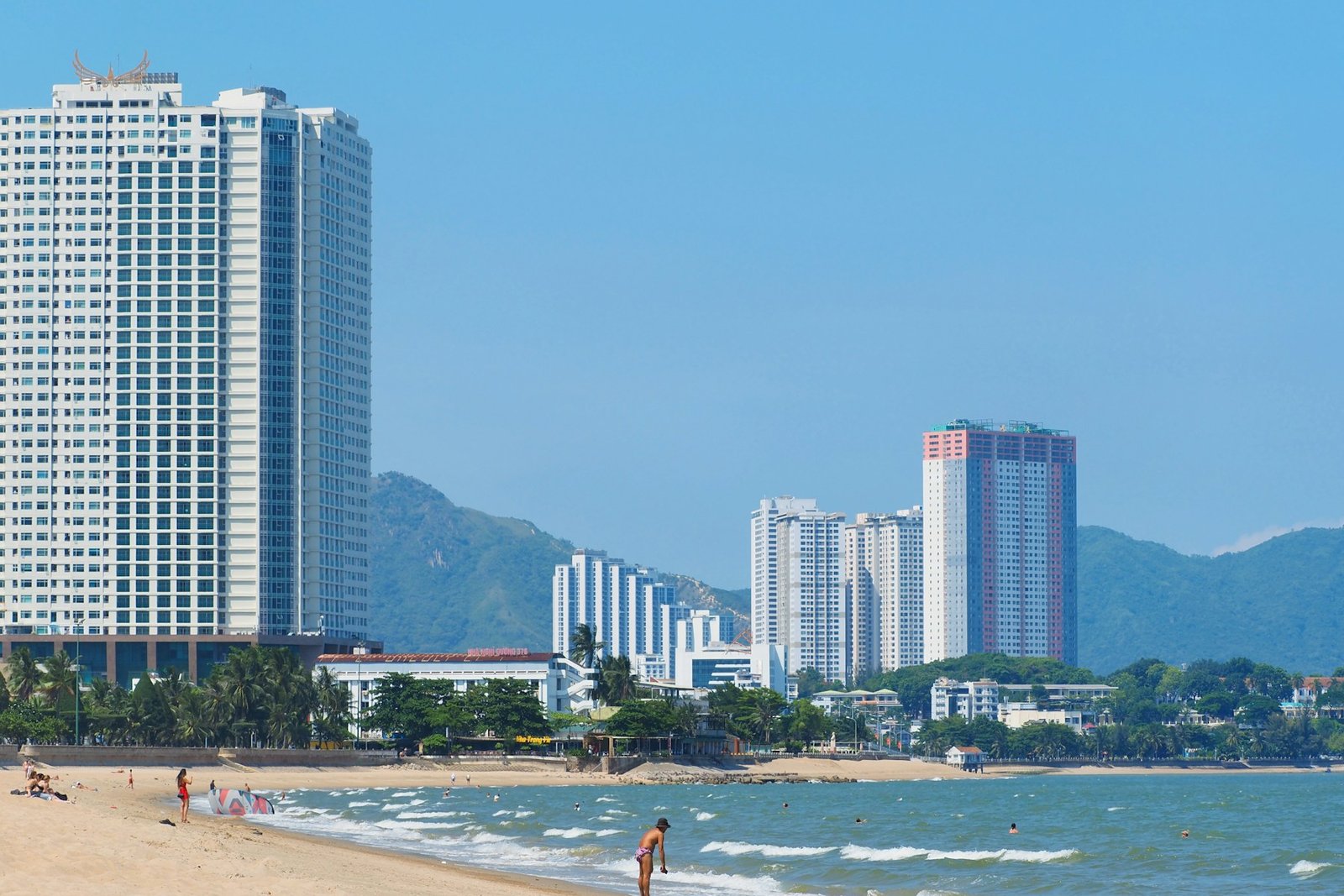
A long strip of beachfront hotels, from budget rooms a block back to the large international resorts on the sand. It is the largest concentration of accommodation in the city.
You get a proper beach, a lot of choice at every price, and the city behind you. You also get a strip that is genuinely built up, with the character that implies. The Ancient Town is around forty-five minutes away by car, so this is a base for Da Nang rather than a base for Hoi An.
Da Nang: the city centre and the Han River
Across the river from the beach: business hotels, apartment blocks, the Han Market, the riverfront and the bridges. Cheaper than the beachfront, and closer to where the city actually eats.
It suits short stops, early flights, and travellers who would rather be in a working city than on a resort strip. The beach is a short Grab ride when you want it.
Da Nang: An Thuong
The grid of streets a block or two back from My Khe beach, with small hotels, hostels, cafes and western-facing restaurants. Cheaper than the beachfront, walkable to the sand, and where a good deal of the longer-stay and remote-working crowd ends up.
It suits anyone who wants the beach without resort prices, and anyone staying more than a few nights. It is less suitable if you want a quiet residential street or a view.
What the choice turns on
Three questions settle most of it. How many nights do you have in the region? Is the Ancient Town the point of the stay, or one thing among several? And are you travelling in the dry stretch or the storm season?
Two nights with the old town as the reason: stay in it. Four or more with beach time: An Bang, or split. A week, a family, or a flight at either end: Da Nang, and treat Hoi An as a day and an evening out.
The split
Two nights in each is a common shape and costs one transfer. It is the version that gets you the Ancient Town early and late, and a city with an airport at the end of the leg.
Practical points before you book
Ask whether the property runs a shuttle to the Ancient Town and at what times — it changes how easily you get to dinner from anywhere outside the centre. Check the walking distance from the hotel to the old town rather than the stated distance to "Hoi An", which can mean the district.
In Hoi An, check how close the property is to the river if you are travelling between September and November; the streets nearest the water flood in some years. In Da Nang, check which side of the river you are on, because the bridges add time at busy hours.
What you are paying for
The pattern across both places is that the premium sits on position rather than on the room. Put a central Ancient Town room next to a larger room with a pool ten minutes out at the same price, and what separates them is whether you walk home from dinner. On the Da Nang beachfront the premium is the sand, and a block back it disappears quickly.
That makes the useful question not "how much" but "what does this position save me each day", which is answerable before you book.
Booking
Both places are heavily supplied with accommodation at every level, and outside the main holiday periods there is usually availability. The exception is the lunar new year period and the local holiday weeks, when the domestic travel market fills the coast.
For deciding how many nights this region gets within the wider trip, Vietnam, End to End works through the itinerary order.
FAQ
What is it like to stay inside Hoi An Ancient Town?
Small hotels and converted houses on and immediately around the old streets. You walk to the restaurants, the tailors, the riverside and the lantern-lit streets at night, and you can be out in the town at the hours when it is quietest. (This article contains affiliate links — if you book through them we earn a small commission at no extra cost to you.)
What is An Bang beach like as a base?
Low-rise guesthouses, villas and small resorts behind a wide beach, roughly ten to fifteen minutes from the Ancient Town by bicycle. Beach restaurants, a slower pace, and sand at the door.
What is the Da Nang beachfront like?
A long strip of beachfront hotels, from budget rooms a block back to the large international resorts on the sand. It is the largest concentration of accommodation in the city.