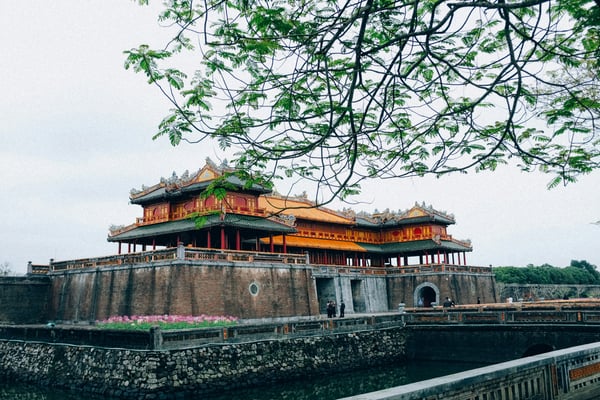
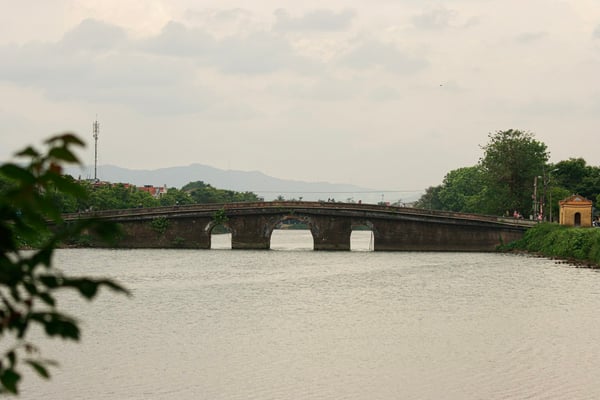
Hue was the capital of Vietnam under the Nguyen dynasty, the country's last ruling house, and the seat of its emperors until the middle of the twentieth century. What remains is a walled citadel on the north bank of the Perfume River, a scatter of royal tombs in the hills outside, and a distinct court cuisine.
The shape of the city
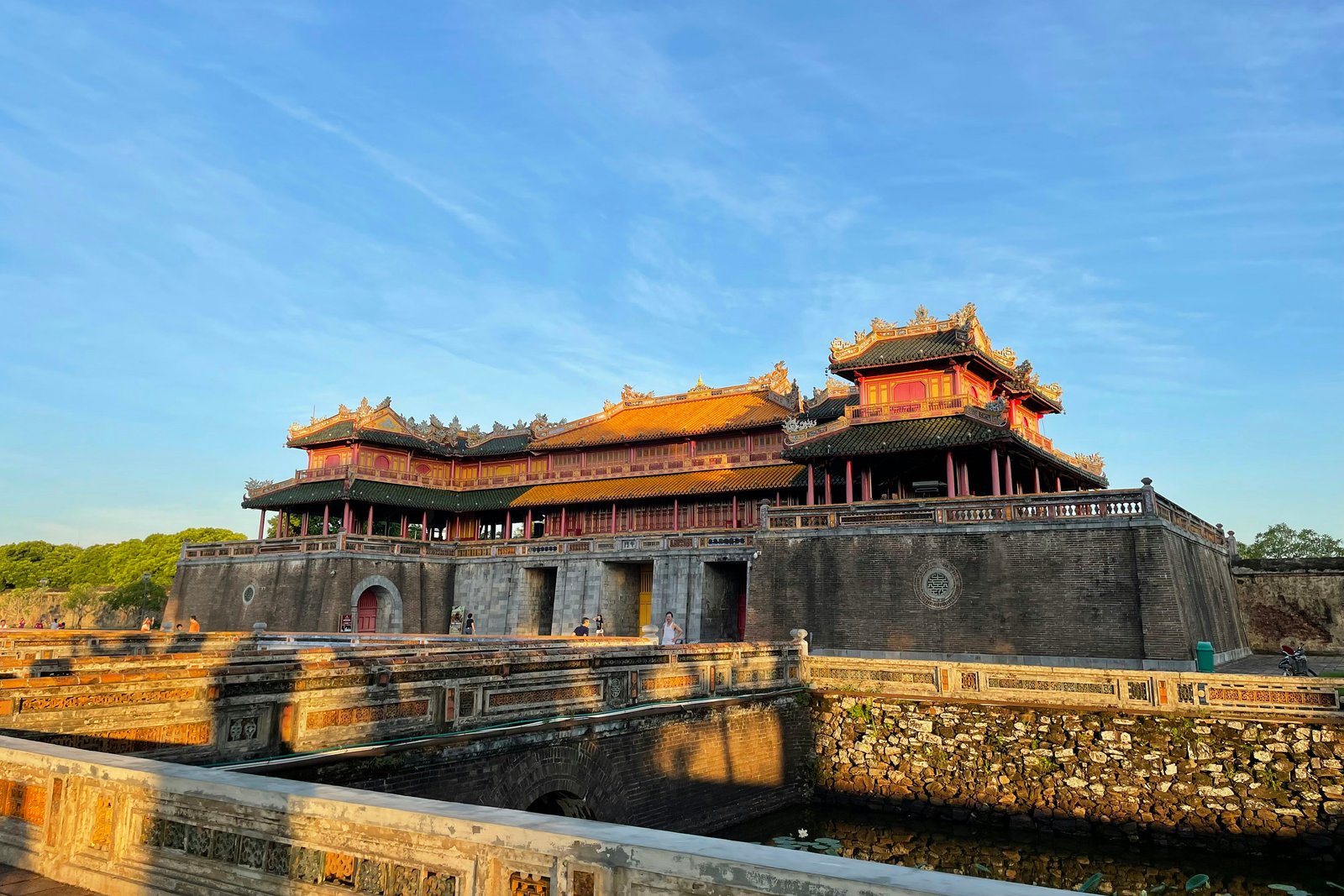
The Perfume River divides Hue. On the north bank is the Citadel — a walled and moated enclosure holding the Imperial City, which held the Forbidden Purple City at its centre. On the south bank is the modern town: most of the hotels, the restaurants, the backpacker streets and the riverside promenade.
The two are connected by bridges and the distances are walkable in good weather; a Grab is the easy way across.
The Citadel on the north bank: Hue · Hue Imperial City. (Enable JavaScript for the interactive map.)
What to see
The Imperial City is the main event and needs a half day on its own. Beyond it, the royal tombs are what distinguish Hue from anywhere else in Vietnam — each emperor built his own, and they are spread through the countryside south and west of the city, set in gardens, lakes and pine.
The three usually included on a tour circuit are Minh Mang, Tu Duc and Khai Dinh, and they are deliberately unalike: Minh Mang formal and symmetrical, Tu Duc rambling and overgrown, Khai Dinh a dark concrete hybrid of Vietnamese and European styles. Seeing two or three is better than trying to see them all.
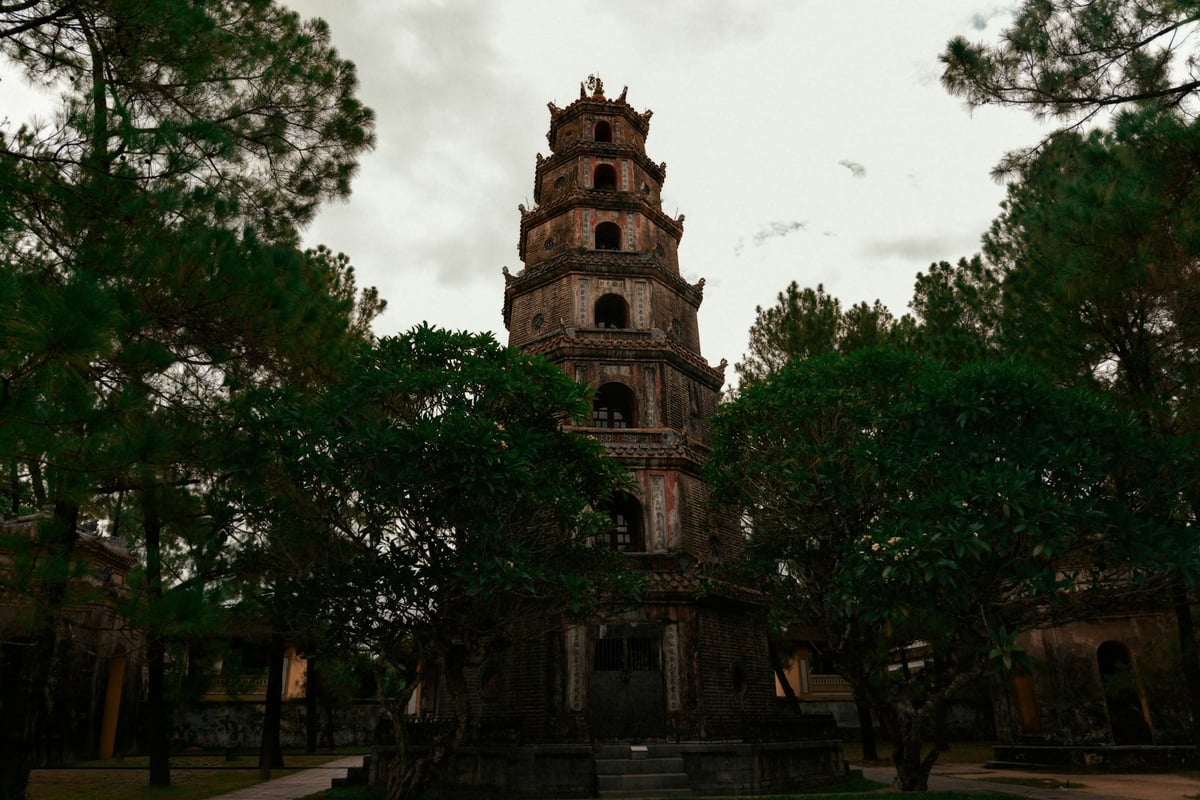
Thien Mu Pagoda
A seven-tiered tower on a rise above the river, a few kilometres upstream from the Citadel, and one of the images associated with the city. It can be reached by road or by dragon boat along the Perfume River, and the boat is the pleasanter approach.
Getting around the tombs
The tombs are not walkable from the centre and not close to each other. The usual options are a hired car with a driver for a half or full day, a motorbike taxi arrangement, a bicycle for the nearer ones if you are fit and the weather allows, or a boat trip that combines a pagoda with one or two tombs.
A car with a driver is the straightforward version. Agree the list of stops and the price before setting off, and expect each tomb to need thirty to sixty minutes.
The Perfume River
Dragon boats run upstream from the city towards Thien Mu and, on the longer trips, on to one or two of the tombs. The boats are slow and the commentary is limited, but the river is the thread the whole city was laid out along, and seeing it from the water reorders the map in your head.
Shorter evening cruises also run from the south bank. Agree the route and price before boarding, and be clear whether tomb entry fees are included.
The food
Hue has a culinary reputation within Vietnam that is out of proportion to its size, a legacy of the court. Bun bo Hue, a beef and lemongrass noodle soup, is the dish that travelled; it is spicier and more robust than northern pho and is eaten here at breakfast.
Beyond it the city is known for a family of small steamed and savoury cakes — banh beo, banh nam, banh loc — usually served as a set of little dishes. Com hen, rice with baby clams, is the local speciality that is easiest to overlook.
Where to eat it
The south bank has the restaurants aimed at visitors; the better bun bo Hue is generally found at small specialist places that sell one dish and open early. The Dong Ba market on the north bank near the Citadel is the other place to eat, and is the city's main market besides.
When to go
Hue sits on the central coast and shares its weather pattern. September to November is the storm season, and Hue has a reputation for rain that extends beyond it — the city is wetter than Da Nang and Hoi An through much of the cool season. The drier, hotter stretch runs roughly from February to August.
Plan indoor-tolerant days if you are there in the wet months. The Imperial City is largely open ground and is a much better visit in dry weather.
How long to stay
One full day covers the Imperial City and one or two tombs at a brisk pace. Two days lets you do that without rushing and add the pagoda, the market and an evening on the river. More than two is for people with a specific interest in the dynasty or the food.
Many itineraries give Hue a single night on the way between Hanoi and Hoi An. That works, but it means choosing between the Citadel and the tombs rather than seeing both properly.
Getting there and away
Hue has its own airport with domestic flights, and a station on the north-south railway. The coastal train south to Da Nang is one of the best rail stretches in Southeast Asia. North, the overnight train and the flights both run to Hanoi.
The DMZ and the Vinh Moc tunnels are a day trip north of the city, and they are the reason some visitors give Hue an extra night.
FAQ
How is Hue laid out?
The Perfume River divides Hue. On the north bank is the Citadel — a walled and moated enclosure holding the Imperial City, which held the Forbidden Purple City at its centre. On the south bank is the modern town: most of the hotels, the restaurants, the backpacker streets and the riverside promenade.
What should you see in Hue?
The Imperial City is the main event and needs a half day on its own. Beyond it, the royal tombs are what distinguish Hue from anywhere else in Vietnam — each emperor built his own, and they are spread through the countryside south and west of the city, set in gardens, lakes and pine.
How do you get around the royal tombs?
The tombs are not walkable from the centre and not close to each other. The usual options are a hired car with a driver for a half or full day, a motorbike taxi arrangement, a bicycle for the nearer ones if you are fit and the weather allows, or a boat trip that combines a pagoda with one or two tombs.
Keep planning
Not sure how it all fits together?
Pick your trip length and we'll route a real day-by-day plan.