You do not need Vietnamese to travel in Vietnam, and almost nobody expects an American visitor to have any. A handful of words still changes how interactions go, mainly because so few foreigners attempt them. Here is the short list and the pronunciation problem you need to know about.
The pronunciation problem
Vietnamese is tonal: the same syllable carries different meanings depending on the pitch contour, and the northern standard uses six tones. The diacritics in written Vietnamese mark them, which is why the phonetic approximations below are rough guides rather than reliable pronunciation — they cannot carry the tone.
The practical consequence is that you will frequently be misunderstood, and that this is normal rather than a failure. Pointing, smiling and showing something written down are legitimate parts of communicating, and nobody minds.
North and south differ
Pronunciation varies noticeably between Hanoi and Ho Chi Minh City — the letter spelled d sounds like a z in the north and a y in the south, among other differences. Both are understood everywhere; it is worth knowing so that a phrase that worked in Hanoi sounding different in Saigon does not confuse you.
The six that earn their place
Xin chào — hello. Roughly sin chow. Understood everywhere and probably the most useful word here.
Cảm ơn — thank you. Roughly gam un in the north, cam un in the south.
Bao nhiêu? — how much? Roughly bow nyew. Pair it with pointing.
Không — no. Roughly khom. Also used constantly to decline politely.
Ngon quá — delicious. Roughly ngon kwa. Said to whoever cooked your food, it tends to be very warmly received.
Tính tiền — the bill, please. Roughly ting tien.
And one for the beer
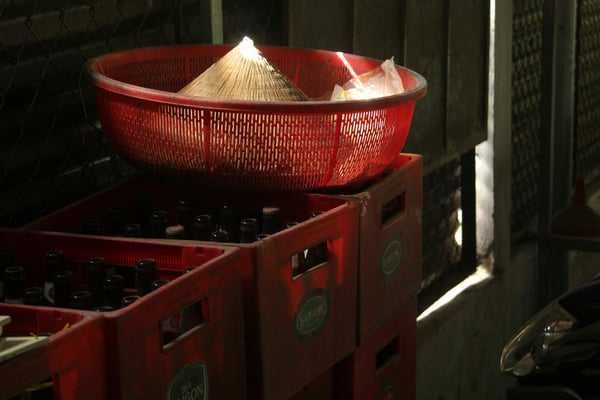
Một hai ba, yô — one two three, cheers. Roughly mot hai ba, yo. You will hear it around the bia hoi corners in the early evening, and joining in generally goes down well.
Why the tones matter in practice
A worked example makes it concrete. The syllable written ma means different things across the tones — ghost, cheek, but, tomb, horse, rice seedling — distinguished only by pitch. Nothing in the consonants or vowels separates them.
That is why a phrase learned from a phonetic spelling often does not land, and why pointing at written Vietnamese works when speaking it does not. It is also why nobody should feel embarrassed about the attempt: Vietnamese speakers know perfectly well that the tones are the hard part, and they are generally delighted that you tried.
Addressing people
Vietnamese uses different pronouns depending on the relative age of the person you are speaking to, and getting it exactly right is beyond a short trip. Two are worth knowing: anh for a man around your age or a little older, and chị for a woman in the same bracket. Adding them after xin chào is warmer than the bare greeting.
If in doubt, a greeting with a smile and no pronoun is fine. Nobody is grading you.
Numbers worth recognising
Prices are usually written down or shown on a calculator or phone, which solves most of the problem. The one thing worth knowing is that Vietnamese commonly drops the thousands when speaking about money: a price said as hai mươi, twenty, in a market generally means twenty thousand dong.
That shorthand catches a lot of visitors out, and simply knowing about it removes most of the confusion.
Reading a menu
A few words recurring everywhere: phở noodle soup, bún rice vermicelli, cơm rice, bánh mì the baguette sandwich, gà chicken, bò beef, heo or lợn pork, chayvegetarian. That handful decodes a surprising proportion of what you will be looking at.
A few more if you want them
Xin lỗi — sorry, or excuse me to get attention. Roughly sin loy.
Vâng or dạ — yes, with da also serving as a polite particle. Roughly vung, ya.
Nhà vệ sinh ở đâu? — where is the toilet? Roughly nya ve sing uh dow.
Tôi không ăn được thịt — I cannot eat meat. Worth having written down rather than spoken if it matters medically, since fish sauce is in almost everything and vegetarian in practice often means no visible meat.
The one to get right
If you learn the pronunciation of only one thing properly, make it cảm ơn. It is the phrase you will use most, it is short, and it is the one that most reliably produces a smile rather than a blank look.
Tools
Google Translate handles Vietnamese reasonably and its camera mode on menus is genuinely useful. Download the offline Vietnamese pack before you travel. For anything important — an address, a dietary restriction, a medical issue — have it written down in Vietnamese rather than relying on speaking it.
FAQ
Why is Vietnamese hard to pronounce?
Vietnamese is tonal: the same syllable carries different meanings depending on the pitch contour, and the northern standard uses six tones. The diacritics in written Vietnamese mark them, which is why the phonetic approximations below are rough guides rather than reliable pronunciation — they cannot carry the tone.
Do the tones really matter in practice?
Xin chào — hello. Roughly sin chow. Understood everywhere and probably the most useful word here.
How do you address people in Vietnamese?
A worked example makes it concrete. The syllable written ma means different things across the tones — ghost, cheek, but, tomb, horse, rice seedling — distinguished only by pitch. Nothing in the consonants or vowels separates them.
Keep planning
Not sure how it all fits together?
Pick your trip length and we'll route a real day-by-day plan.