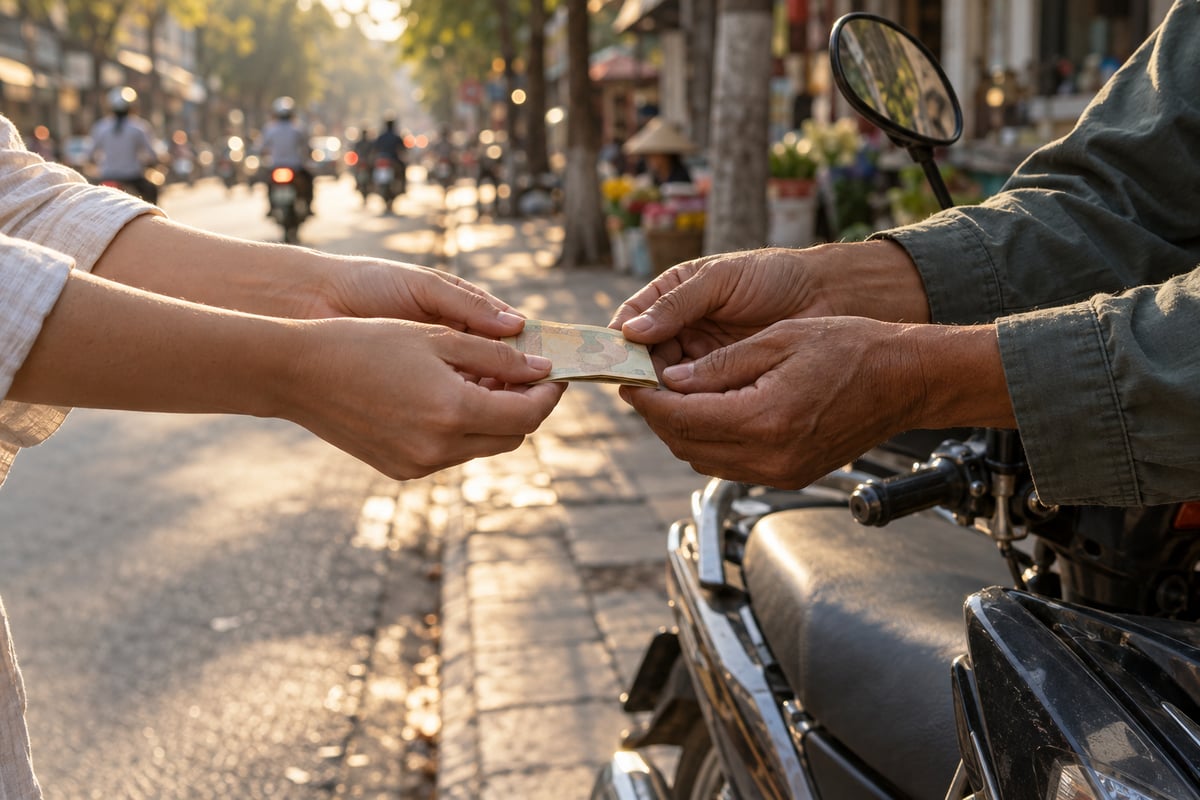
Tipping is not customary in Vietnam, and walking out of a restaurant having left nothing is a completely normal thing to do. For American travellers that takes some unlearning, because the reflex runs deep and the anxiety about getting it wrong is usually larger than the stakes.
The default: no tip, no offence
Vietnam has no tipping culture in the American sense. Service staff are not paid a sub-minimum wage topped up by gratuities, the price on the menu is the price, and nobody is calculating a percentage as you leave. At a street stall, a local pho shop, a bahn mi cart or a neighbourhood cafe, you pay what you owe and you go.
That is the baseline to start from, because the common American failure mode here is not stinginess. It is over-tipping from nervousness, which is a small problem rather than a large one but adds up across three weeks and quietly distorts prices in heavily touristed places.
Why the advice online disagrees with itself
Tourism has imported the habit into tourist-facing businesses, so you will find confident articles saying tipping is expected and equally confident ones saying it is not. Both describe something real. The honest version is that tipping is absent from ordinary Vietnamese life and present at the tourist interface, and knowing which one you are standing in is the whole skill.
Where it genuinely is expected
A short list covers nearly everything. Private guides and drivers hired for a day or longer, spa and massage therapists, hotel porters who carry bags, and cruise crews on Ha Long Bay overnight boats, where the convention is a pooled envelope collected at the end rather than individual tips. In those situations a tip is anticipated and its absence is noticed.
Amounts are modest. As customary gestures rather than fixed rates, and indicative as of October 2026: 20,000 to 50,000 dong for a porter or a spa therapist; 100,000 to 200,000 dong per day for a private guide or driver, more if they have gone well beyond the job; and in a Western-facing restaurant with no service charge, rounding up or around ten percent. A pooled cruise envelope is usually a few dollars per passenger per day.
The useful rule underneath those numbers is proportionality: a tip in Vietnam is a gesture, not a percentage, and it should feel small relative to what the service cost.
Restaurants and the service charge
Mid-range and upper restaurants, especially in Hanoi and Ho Chi Minh City, increasingly add a service charge to the bill, often alongside VAT. When that line is there, the tipping question is already settled and anything further is optional. Read the bottom of the bill before reaching for extra.
In Western-facing restaurants and bars without a service charge, rounding up or leaving small change is common and welcome. Nobody will chase you down the street if you do not.
Hotels
At a budget guesthouse nobody expects anything. At a mid-range or upper hotel, porters who carry bags to your room are tipped a small note, and housekeeping is sometimes left something at the end of a multi-night stay rather than daily. Neither is obligatory, and a Vietnamese guest would often leave nothing.
Taxis, Grab and the rounding habit
Taxi drivers do not expect tips, and rounding up to avoid fiddling with small notes is the normal gesture. Grab fixes the fare before the ride, which at least removes any argument about the price; tipping is a separate question, and the app has a tip option that drivers appreciate on long or awkward trips. Some Grab rides are still settled in cash to the driver.
One thing worth knowing: with a metered taxi, drivers frequently do not carry much change. Having small notes is more useful to everyone than a tip, and it prevents the familiar standoff where a 500,000 note cannot be broken.
Barbers, nail salons and small services
These sit on the boundary and the honest answer is that it depends who is around you. In a neighbourhood shop where the clientele is local, pay the posted price. In a salon on a tourist street with English signage and prices to match, a small tip is common and expected. Judge the room rather than the service type.
How to tip without making it awkward
Hand money directly to the person rather than leaving it on a table, use both hands or your right hand supported at the left elbow, and do it quietly. A tip presented with ceremony can read as a performance of generosity rather than thanks, which lands badly.
Tip in dong rather than dollars. Foreign notes have to be changed, small denominations often cannot be changed at all, and a few dollar bills are worth less to the recipient than the same value in usable local currency. The exception is a pooled cruise envelope, where dollars are commonly accepted.
The one that is not a tip
If someone performs an unrequested service and then names a price — a shoe repair begun while you are standing still, a photograph taken with a conical hat and a shoulder pole — that is a transaction you did not agree to, not a tipping situation. Decline before it starts rather than paying afterwards. Our wider look at how prices get set in these moments is in our honest assessment of safety in Vietnam, and the same habit of fixing the number first is one strand of the cash-and-cards planning that Vietnam, End to End works through.
FAQ
Do you tip in Vietnam?
Vietnam has no tipping culture in the American sense. Service staff are not paid a sub-minimum wage topped up by gratuities, the price on the menu is the price, and nobody is calculating a percentage as you leave. At a street stall, a local pho shop, a bahn mi cart or a neighbourhood cafe, you pay what you owe and you go.
Where is tipping genuinely expected in Vietnam?
A short list covers nearly everything. Private guides and drivers hired for a day or longer, spa and massage therapists, hotel porters who carry bags, and cruise crews on Ha Long Bay overnight boats, where the convention is a pooled envelope collected at the end rather than individual tips. In those situations a tip is anticipated and its absence is noticed.
Do you tip taxi and Grab drivers in Vietnam?
Taxi drivers do not expect tips, and rounding up to avoid fiddling with small notes is the normal gesture. Grab fixes the fare before the ride, which at least removes any argument about the price; tipping is a separate question, and the app has a tip option that drivers appreciate on long or awkward trips. Some Grab rides are still…