Vietnam's religious buildings come from several different traditions, and a visitor who treats them all as "temples" misses most of what is interesting. Here is what the main kinds are, how to recognise them, and how to behave inside.
Chua — the Buddhist pagoda
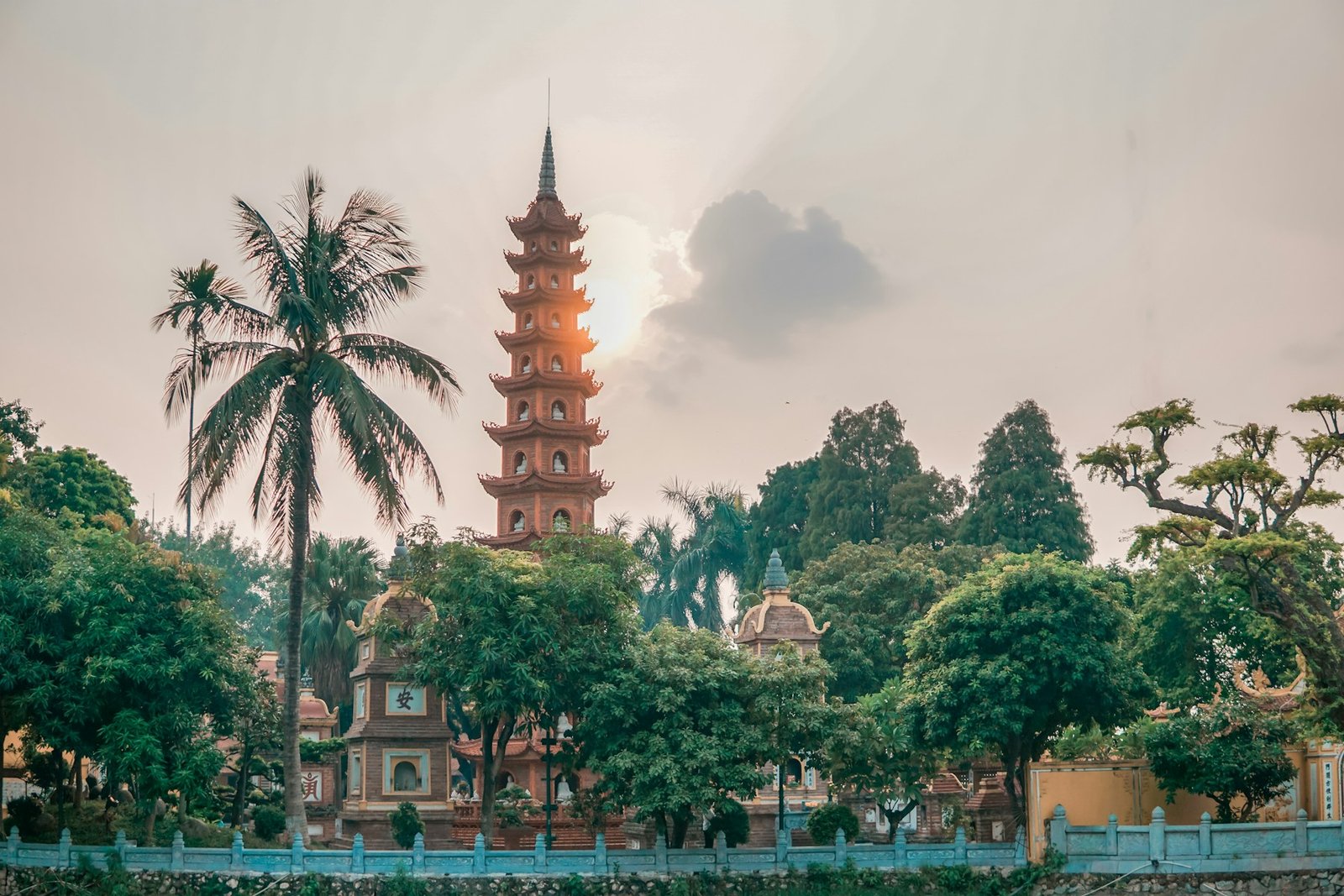
The most common. A chua is a Buddhist place of worship, usually a complex of halls around courtyards rather than a single building, with a main hall holding Buddha statues, incense burners, and often a bell and a drum.
Vietnamese Buddhism is predominantly Mahayana in the north and centre, which is why you will see Quan Am — the bodhisattva of compassion, the Vietnamese form of Guanyin — very frequently, often as a white standing figure outside. In parts of the south and the Mekong, Theravada Buddhism of the Khmer tradition appears instead, and those temples look quite different: taller, more ornate, closer to Cambodian architecture.
Den — the temple
A den honours a person or a spirit rather than the Buddha: a national hero, a historical general, a mother goddess. Den Ngoc Son on Hoan Kiem lake in Hanoi is one; the Tran Hung Dao temples across the north are others. They often look similar to a chua from outside and the difference is who is on the altar.
Van Mieu — the Confucian temple of literature
Dedicated to Confucius and to scholarship rather than to a deity. The one in Hanoi was Vietnam's first university and has stone stelae on turtles' backs recording the names of doctoral graduates from the fifteenth century on. Several provincial cities have smaller versions.
Dinh — the communal house
The village hall and the shrine of the village's tutelary spirit, usually the oldest and most elaborately carved wooden building in an old village. These are not tourist sites and are often closed, but the woodwork inside the ones that open is some of the best in the country.
Cham towers
Brick towers from the Cham civilisation, Hindu rather than Buddhist, found along the central and southern coast. My Son near Hoi An is the largest group; Po Nagar in Nha Trang and the towers around Phan Rang are others. The architecture reads closer to Indian and Khmer temple building than to anything else in Vietnam.
Cao Dai temples
Cao Dai is a Vietnamese religion founded in the 1920s, syncretic and visually unmistakable: bright colours, a divine eye above the altar, and a congregation in white. The Great Temple at Tay Ninh, north-west of Ho Chi Minh City, is the centre and is the usual place visitors see one. Services run at set times and visitors are welcome at the back.
Churches
Vietnam has a substantial Catholic population and the French-era churches are a visible part of the urban landscape — St Joseph's in Hanoi, the Notre-Dame basilica in Ho Chi Minh City, the pink church in Da Lat, and the stone cathedral at Phat Diem, which was built in Vietnamese temple style.
What is usually inside a chua
The layout repeats enough to be worth learning. A triple gate or an entrance arch; a courtyard, often with a bodhisattva figure and a pond; the main hall with tiered altars, the largest Buddha figures at the back and offerings of fruit and flowers in front; a bell and a drum, either in the hall or in their own small towers; and behind or beside it, an ancestral hall with photographs of the dead and the monks of the pagoda.
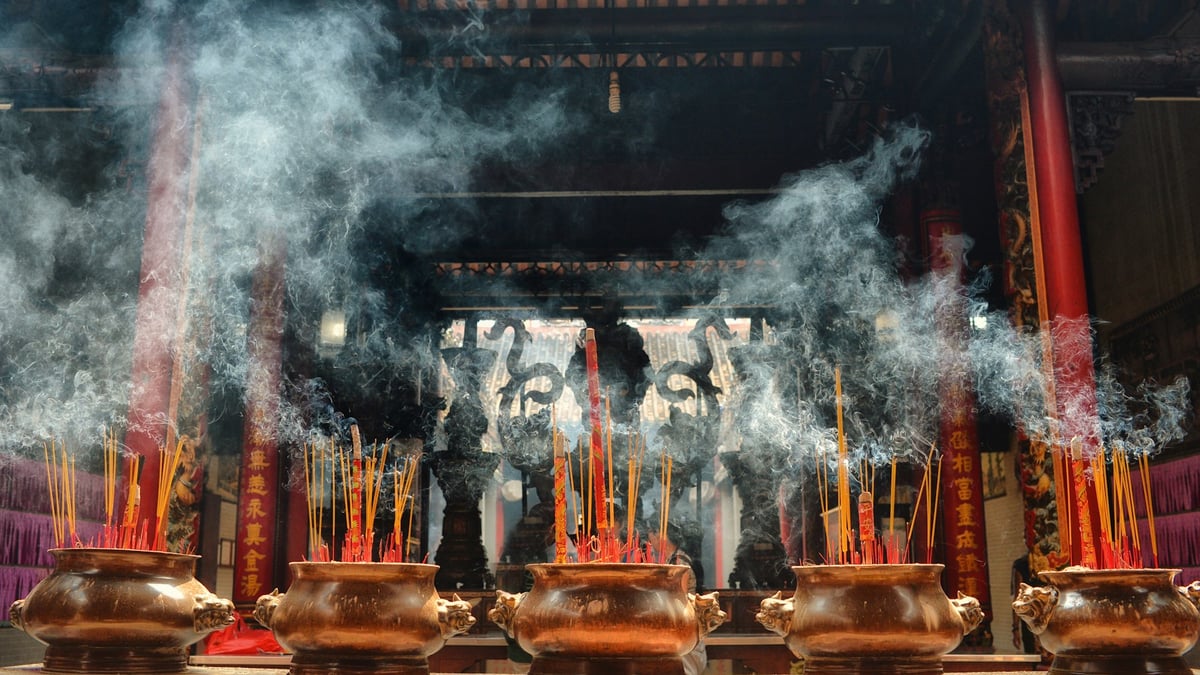
Incense burners stand outside the hall doors. The smoke and the stacked coils hanging from the ceiling in busier pagodas are the first thing you will notice.
How to behave
Cover shoulders and knees. Remove shoes where you see others doing so, which is usually at the threshold of an inner hall rather than the courtyard. Step over the raised threshold rather than on it.
Do not point your feet at an altar or a statue, which means watching how you sit. Walk around a statue rather than in front of someone praying. Ask before photographing people at worship, and look for signs prohibiting photography inside halls.
If you want to offer incense, buy it at the gate, light it, hold it at forehead height with both hands, bow, and place it in the burner. It is a normal thing for a visitor to do and it is not expected of you; at a few sites photography or lay offerings are restricted, so look for signs first.
The ones worth going out of your way for
The Perfume Pagoda south of Hanoi, which is a boat trip and a climb. Bai Dinh and the Trang An complex at Ninh Binh, vast and modern. Thien Mu above the Perfume River at Hue. The Marble Mountains caves near Da Nang, where the shrines are inside the rock. Linh Ung on the Son Tra peninsula with its tall Lady Buddha. And the Cao Dai Great Temple at Tay Ninh, which is unlike anything else in the country.
Most of these are covered in their own right elsewhere on this site; what they have in common is that the setting is as much the point as the building.
Donations
Boxes are provided and contributions are voluntary. At some popular sites you will be offered incense or a blessing by someone who then expects payment; that is a transaction rather than a temple custom, and declining is fine.
FAQ
What is a chua?
The most common. A chua is a Buddhist place of worship, usually a complex of halls around courtyards rather than a single building, with a main hall holding Buddha statues, incense burners, and often a bell and a drum.
What is Van Mieu, the Temple of Literature?
Dedicated to Confucius and to scholarship rather than to a deity. The one in Hanoi was Vietnam's first university and has stone stelae on turtles' backs recording the names of doctoral graduates from the fifteenth century on. Several provincial cities have smaller versions.
What is a dinh, or communal house?
The village hall and the shrine of the village's tutelary spirit, usually the oldest and most elaborately carved wooden building in an old village. These are not tourist sites and are often closed, but the woodwork inside the ones that open is some of the best in the country.
Keep planning
Not sure how it all fits together?
Pick your trip length and we'll route a real day-by-day plan.